Puppy Confinement Recommendation Tool
Use this tool to determine whether a crate or an exercise pen is best for your puppy based on their age, training status, and your schedule.
Leaving your new puppy alone for the first time feels like a high-stakes test. You’re worried about accidents, chewing hazards, and whether they’ll be okay. The biggest question usually boils down to one choice: should you put them in a puppy crate or a larger exercise pen? There is no single "right" answer that fits every dog, but there is a right answer for your specific situation. Getting this wrong can lead to house-training setbacks or stress; getting it right builds confidence and safety.
The decision depends on three main factors: how long you will be gone, how well-trained your puppy is, and what their personality looks like. Let’s break down the pros, cons, and practical rules for each method so you can make a confident choice today.
Understanding the Role of Confinement
Before choosing between a box and a fence, it helps to understand why we confine puppies at all. It isn’t about punishment. In fact, most trainers agree that proper confinement is a tool for security. Puppies are den animals by instinct. They naturally avoid soiling their sleeping area. This biological trait is the foundation of house training.
When you leave the house, your puppy needs a space that is safe from electrical cords, toxic plants, and destructive furniture legs. It also needs to be small enough that they don’t choose one corner to sleep and another to relieve themselves. Whether you use a crate or a pen, the goal is the same: manage their environment so they succeed.
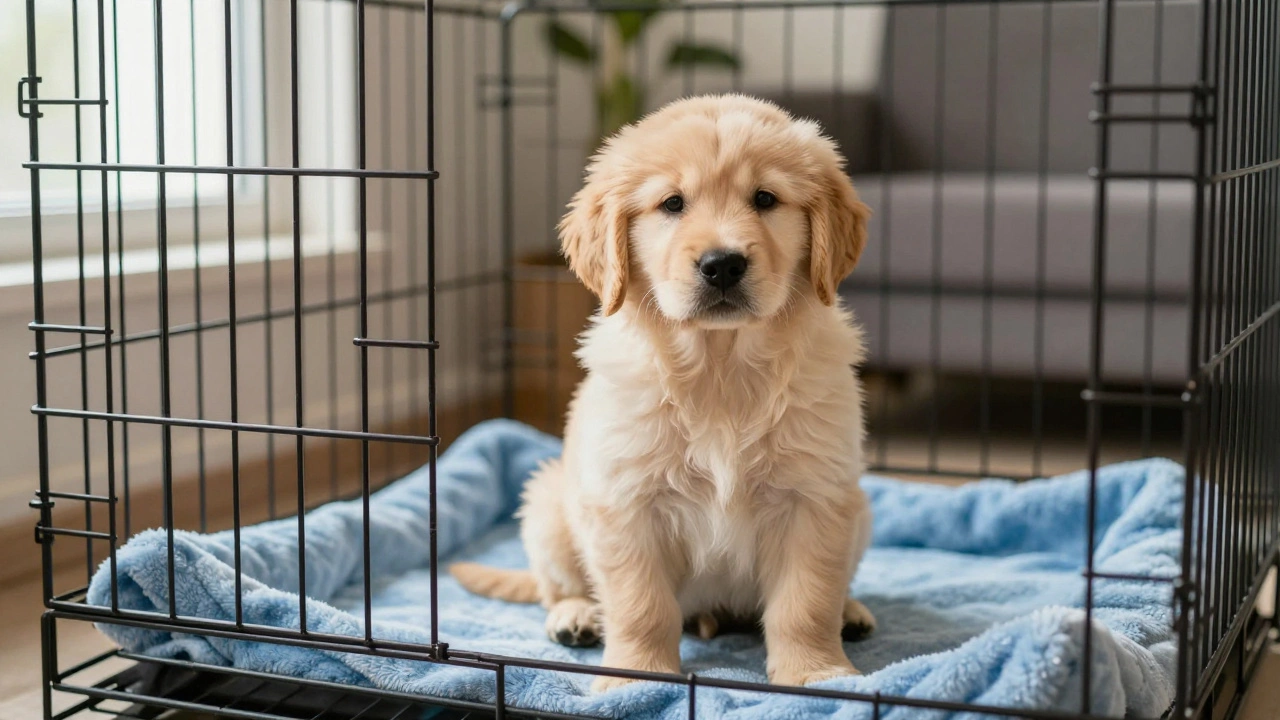
Puppy Crate is a secure, enclosed space designed to mimic a den, primarily used for house training, travel, and short-term confinement when owners are away. It provides a clear boundary and a sense of security for young dogs.
The Case for the Crate: Security and House Training
A crate is often the go-to recommendation for new puppy owners, and for good reason. If your primary goal is house training, the crate is hard to beat. Because the space is limited, your puppy learns to hold their bladder until you let them out. This consistency speeds up the learning process significantly.
Crates also offer a psychological benefit. Many puppies feel safer in an enclosed space than in a large, open room. It reduces visual stimulation and noise, which can help calm a nervous pup. If your dog gets anxious when you leave, a crate with a cover over it can create a quiet sanctuary.
However, crates have strict time limits. A general rule of thumb is that a puppy can hold their bladder for the number of months they are old plus one. So, a three-month-old puppy can typically hold it for four hours maximum. If you need to be gone longer than that, a crate becomes a risky choice. Leaving a puppy in a crate for six or eight hours is not recommended and can lead to accidents and distress.
- Best for: Short absences (under 4-5 hours), active house training, travel, and calming anxious dogs.
- Key Benefit: Prevents accidents by limiting space; reinforces the "den" instinct.
- Risk: Can cause frustration if the puppy is too energetic or needs more room to stretch.
The Case for the Exercise Pen: Space and Comfort
An exercise pen (or playpen) offers a different approach. It gives your puppy a larger area to move around, lie down in different positions, and access toys and water without being trapped in a small box. For older puppies (6 months+) who are already house-trained, a pen can be a more comfortable option for longer absences.
If your puppy has learned to distinguish between a bed area and a potty area, a pen allows them to do both within the confined space. You can set up one side with bedding and the other side with pee pads or a small indoor toilet tray. This setup mimics a real-world scenario where they have some freedom but still boundaries.
However, pens require more setup and supervision during the initial training phase. If your puppy isn’t fully house-trained, a pen might encourage them to sneak off to a corner to go, defeating the purpose of confinement. Additionally, pens take up more floor space in your home, which might not work for smaller apartments.
- Best for: Longer absences (if house-trained), older puppies, and dogs who hate small spaces.
- Key Benefit: More room to move, rest, and play; less claustrophobic.
- Risk: Higher chance of accidents if not properly zoned; requires more space in the home.
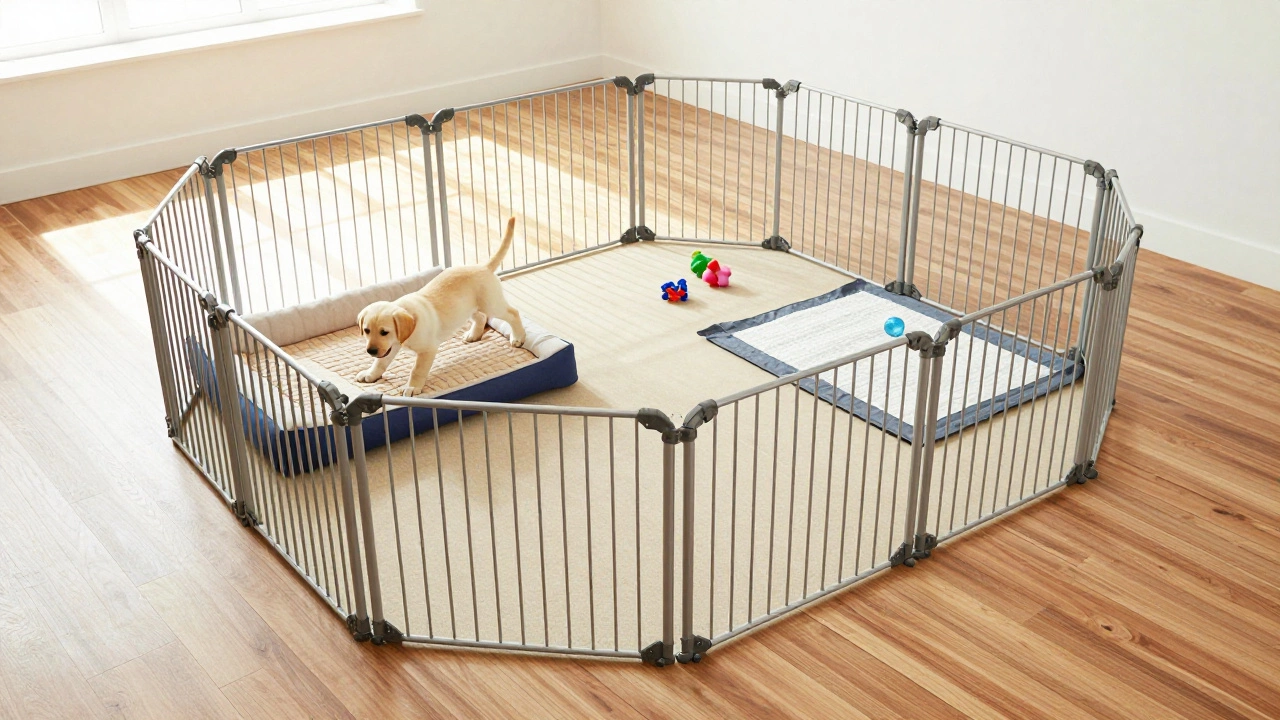
Comparing Crate vs. Pen: A Quick Guide
To help you decide, look at these key differences based on your daily routine and your puppy’s current skills.
| Feature | Crate | Exercise Pen |
|---|---|---|
| House Training Effectiveness | High (limits space) | Medium (requires zoning) |
| Max Time Alone | 4-5 hours (age dependent) | Up to 6-8 hours (if trained) |
| Space Required | Small footprint | Larger footprint |
| Comfort Level | Cozy, den-like | Open, spacious |
| Setup Complexity | Low (just add bed/toy) | Medium (add bed, potty zone, toys) |
How to Choose Based on Your Puppy’s Age
Your puppy’s age is a major factor in this decision. Younger puppies (8-16 weeks) have tiny bladders and limited impulse control. For them, a crate is usually the better starting point. It keeps them safe and helps establish the habit of holding it until outside. As they grow into adolescence (4-6 months), their bladder capacity increases, and they may start testing boundaries. This is a good time to introduce a pen if you plan to be away for longer periods.
If your puppy is already 6 months or older and reliably uses the bathroom outside, a pen might be more humane for longer workdays. They have the physical ability to wait and the mental maturity to respect the boundaries. Always monitor their behavior during the transition. If they start having accidents in the pen, it might be time to go back to the crate for shorter intervals.
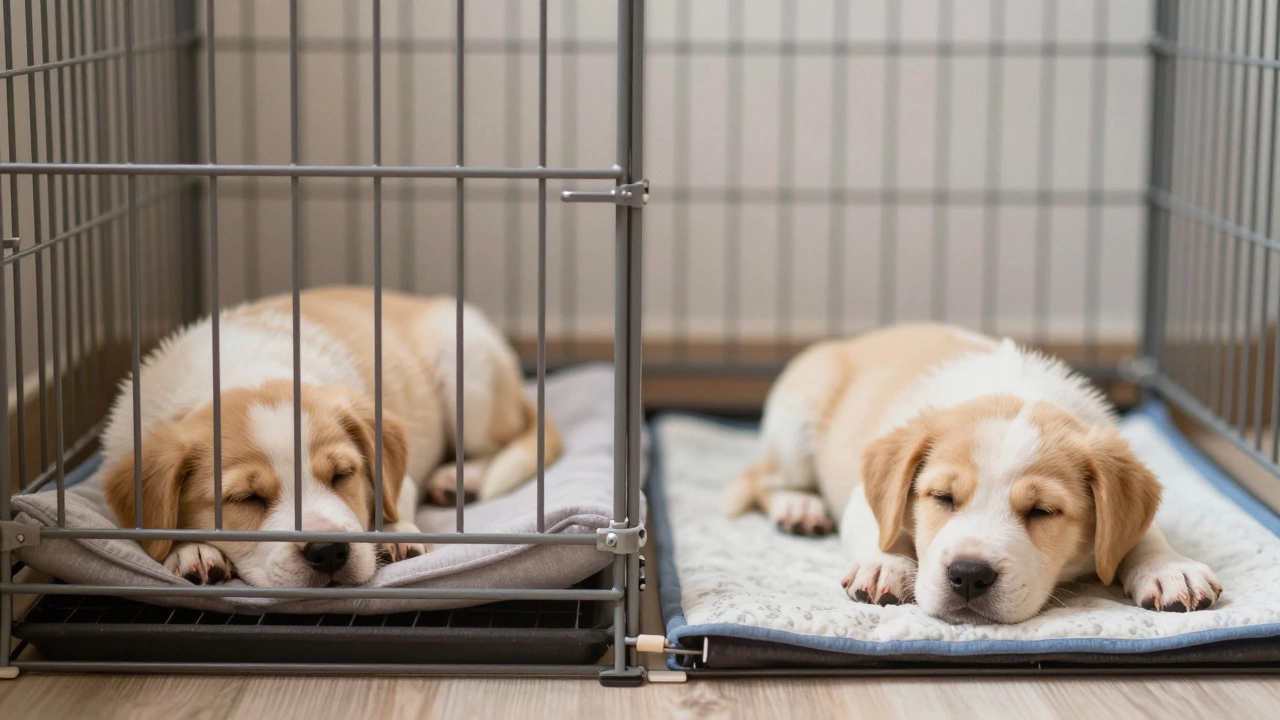
Setting Up the Perfect Safe Space
Whether you choose a crate or a pen, the setup matters just as much as the container itself. A poorly arranged space can lead to boredom, anxiety, or injury. Here is how to prepare either option for success.
- Add Comfort: Include a soft bed or blanket that smells like you. Familiar scents reduce separation anxiety.
- Provide Chews: Give a long-lasting chew toy, like a frozen Kong stuffed with peanut butter or wet food. This keeps them occupied and associates your departure with a positive activity.
- Control Temperature: Ensure the area is cool and well-ventilated. Puppies overheat easily, especially in enclosed spaces.
- Remove Hazards: Check for loose wires, small objects they could swallow, or sharp edges. In a pen, ensure the panels are stable and won’t tip over.
- Create Zones (for Pens): Clearly separate the sleeping area from the potty area. Use visual barriers or different flooring textures to help them distinguish between the two.
Dealing with Separation Anxiety
If your puppy whines, barks, or tries to escape when you leave, they might be experiencing separation anxiety. Neither a crate nor a pen fixes this on its own. In fact, forcing an anxious dog into a crate can sometimes make things worse if they associate the crate with panic.
Start by desensitizing them to your departures. Practice leaving for short periods-just a few minutes-and gradually increase the time. Reward calm behavior when you return. Avoid making a big fuss when you leave or come back; keep greetings low-key. If anxiety persists, consider consulting a professional trainer or veterinarian. Medication or specialized behavioral therapy might be necessary for severe cases.
Remember, consistency is key. Don’t switch between crate and pen randomly. Pick one method and stick with it for a few weeks to see how your puppy responds. Observe their body language. Are they relaxed? Are they sleeping? Or are they pacing and panting? Their behavior will tell you if the setup is working.
Common Mistakes to Avoid
Many new owners make simple errors that undermine their efforts. First, never use confinement as punishment. If your puppy associates the crate or pen with anger or isolation, they will resist it. Always make it a positive place with treats and praise.
Second, don’t leave them alone for too long. Even in a pen, a puppy shouldn’t be isolated for more than 6-8 hours without a break. If you work full-time, consider hiring a dog walker to check in midday. This breaks up the day and gives them a chance to burn energy and go to the bathroom.
Finally, avoid ignoring early signs of distress. Whining occasionally is normal, but continuous crying or destruction indicates a problem. Address it immediately rather than hoping they’ll "get over it." Early intervention prevents long-term behavioral issues.
Can I leave my puppy in a crate for 8 hours?
No, it is generally not recommended to leave a puppy in a crate for 8 hours. Most puppies cannot hold their bladder for that long, leading to accidents and discomfort. A good rule is age in months plus one hour (e.g., a 3-month-old can hold it for 4 hours). For longer absences, consider a dog walker or a larger exercise pen if they are house-trained.
Is a playpen better than a crate for house training?
A crate is usually better for initial house training because it limits space and encourages the puppy to hold their bladder. Playpens offer more room, which can lead to accidents if the puppy hasn’t learned to distinguish between sleeping and potty areas yet. Once house-trained, a playpen can be a comfortable alternative.
What size crate should I get for my growing puppy?
Choose a crate that fits your puppy’s adult size. Use a divider panel to adjust the space as they grow. This prevents them from using one end for sleeping and the other for eliminating. If you buy a small crate now, you’ll need to replace it later, which can confuse the dog.
How do I stop my puppy from whining in the crate?
First, ensure they’ve gone to the bathroom and exercised before crating. Provide a comforting item like a blanket with your scent or a safe chew toy. Ignore occasional whining to avoid reinforcing it, but check if they need to go out. Gradually increase the time they spend in the crate while you’re home to build positive associations.
Can I use a pen if my puppy isn’t house-trained yet?
It’s challenging but possible if you set up distinct zones. Place a bed on one side and pee pads or a litter tray on the other. However, many puppies will still sneak to a corner to go. A crate is more effective for strict house training because it forces them to wait until released.